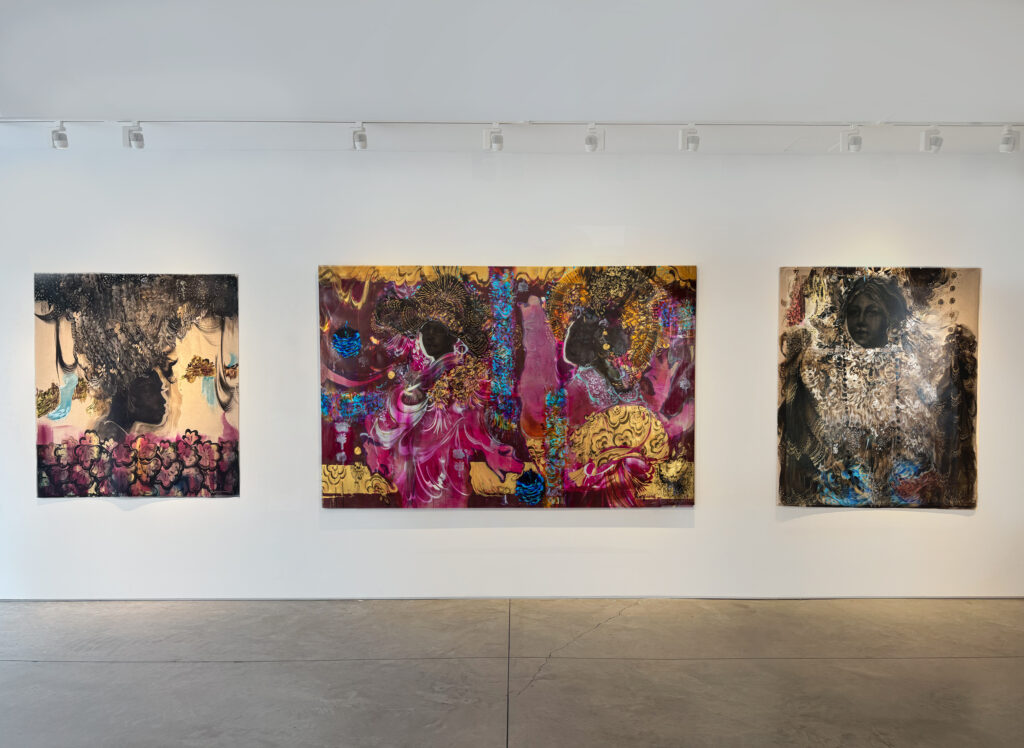
Praxis is pleased to present Golden Skin, a solo exhibition by Scherezade García. The exhibition continues García’s longstanding exploration of identity, migration, ancestry, cultural encounter, and the complex histories that have shaped Las Américas.
Since 1996, a cinnamon-colored figure has appeared throughout García’s work. Her color begins with an act of mixing. García combines the colors on her palette until they become something new, a gesture that for her carries an idea of inclusion. The resulting cinnamon is not intended to describe one particular skin tone. It is a color born from many colors, and the figure that emerges from it carries that same multiplicity. In her paintings, this seemingly singular skin tone is surrounded by intensely chromatic environments of pinks, reds, blues, greens, and golds. What appears to be one color is therefore already made up of many, while the colors surrounding the figure make that multiplicity visible again.
This idea of the figure as a composite is also connected to García’s family. The faces in her paintings are often inspired by photographs of women in her family, including relatives from different generations. They are not portraits in the traditional sense. Instead, individual memories become part of a larger image, allowing the personal and the collective to occupy the same body. The figure becomes a place where histories meet, overlap, and continue to change.
In Golden Skin, this longstanding figure takes on a new radiance. Gold enters García’s visual language not only through its luminosity, but through everything that the color has come to signify: beauty, abundance, spirituality, wealth, desire, and power. Its history in the Americas is equally charged. Gold was one of the forces that shaped European visions of the so called New World, linking ideas of paradise and splendor to conquest and colonial expansion. García holds these contradictions together. Her figures can appear regal and otherworldly, surrounded by ornament and abundance, while the histories beneath that beauty remain present.
This coexistence of beauty and history is central to García’s practice. Her work draws from the many cultures that have encountered one another across the Americas, particularly through the movement of people, objects, beliefs, and images. African, Indigenous, European, Caribbean, and Latin American histories are not presented as separate sources. They are intertwined and transformed through contact. García describes this evolving aesthetic as Afro-Caribbean-Al-Andalus, a language that embraces the richness and complexity produced through these encounters.
The worlds inhabited by her figures reflect this constant transformation. Tropical flora, elaborate textiles, jewelry, lace, religious imagery, and fantastical forms surround their bodies, creating environments that feel at once sacred, theatrical, familiar, and imagined. García’s use of ornament is never simply decorative. It allows different visual traditions to coexist within the same space, creating compositions where histories that have been separated by geography or convention can appear together.
The richness of Golden Skin comes from this refusal to separate things that are often placed in opposition. Sacred and sensual, historical and fantastical, personal and collective, beauty and violence can exist within the same image. García’s visual language is generous enough to contain these contradictions. Gold can evoke both splendor and the history of its pursuit. A religious figure can carry multiple traditions. A family face can become a collective portrait. A single color can hold the traces of many others.
The cinnamon figure therefore remains at the center of García’s work not because she represents a fixed idea of identity, but because she allows identity to remain open. Her skin is a color made through mixture. It is at once intimate and expansive, rooted in personal memory while connected to histories that extend across oceans and generations.
In Golden Skin, García transforms this figure into a luminous presence. Surrounded by water, ornament, vegetation, writing, and the traces of multiple cultural traditions, her figures inhabit a world in which difference is not something to resolve. It is the source of the image itself. Their golden and cinnamon-colored bodies remind us that what we inherit is never entirely fixed, and that new forms of beauty can emerge from everything that has come together before us.