Praxis is pleased to invite you to In The Whitewater, the solo exhibition by Macarena Rojas Osterling (b. 1985, Lima, Perú).
The show will run from Thursday, May 7th through Friday, September 4th, 2026.
The opening reception will be held at Praxis Gallery, 501 W 20 Street, on Thursday, May 14th, from 6 to 8 pm.
‘In The Whitewater’
By Jenn Ellis
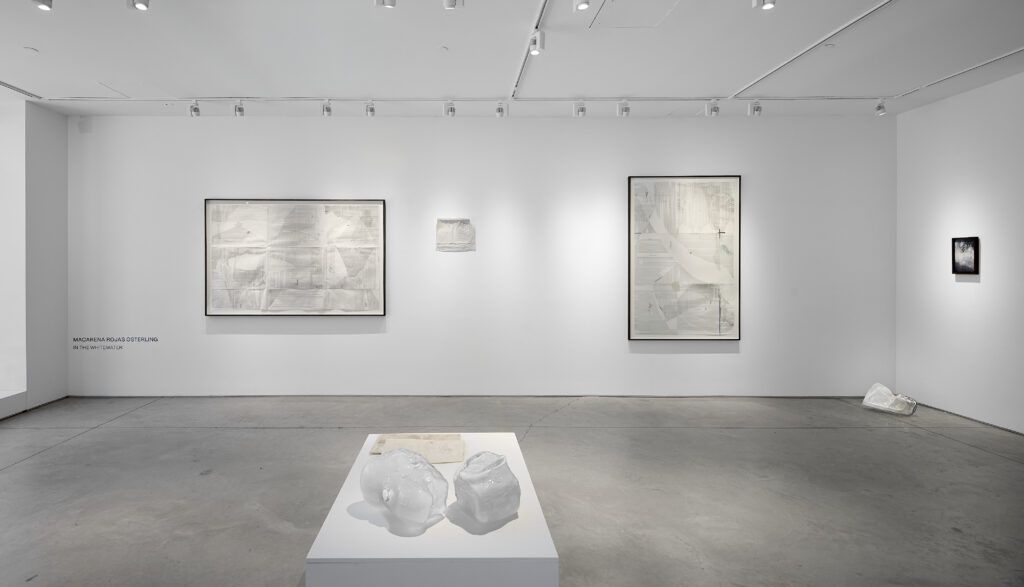
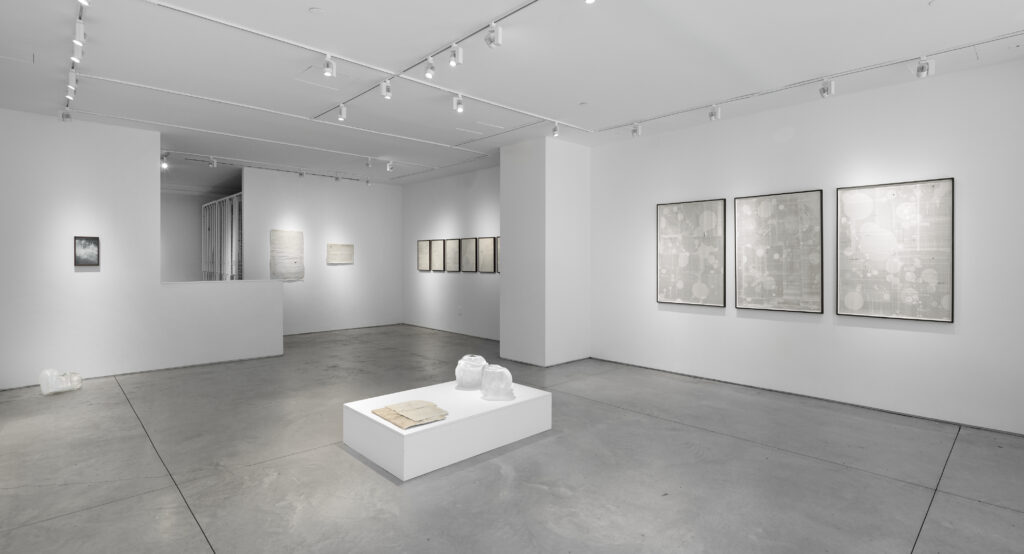
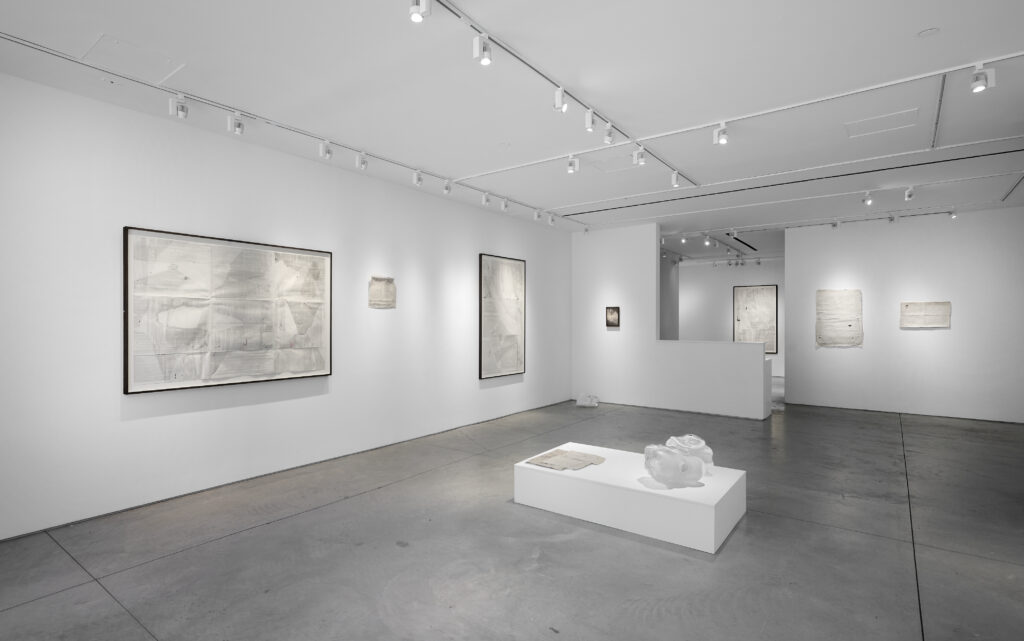
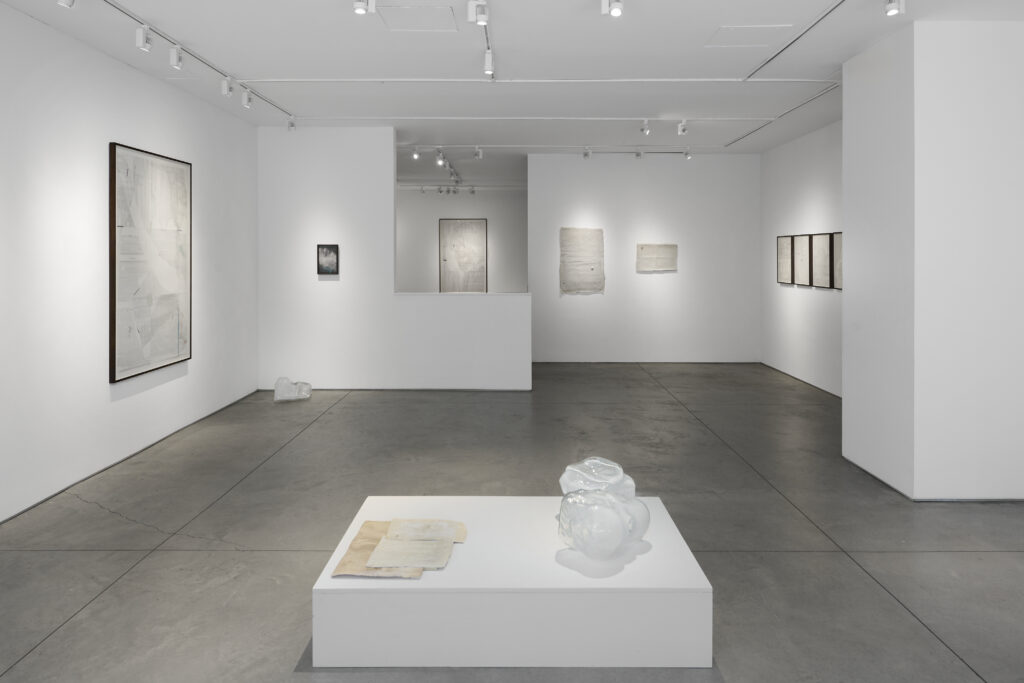
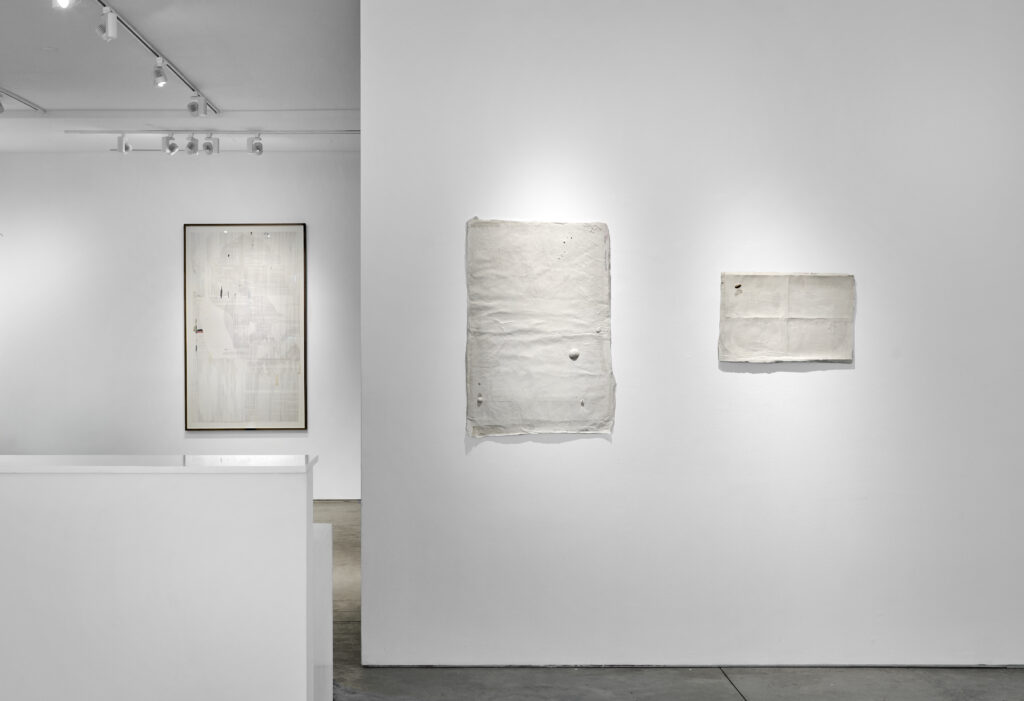
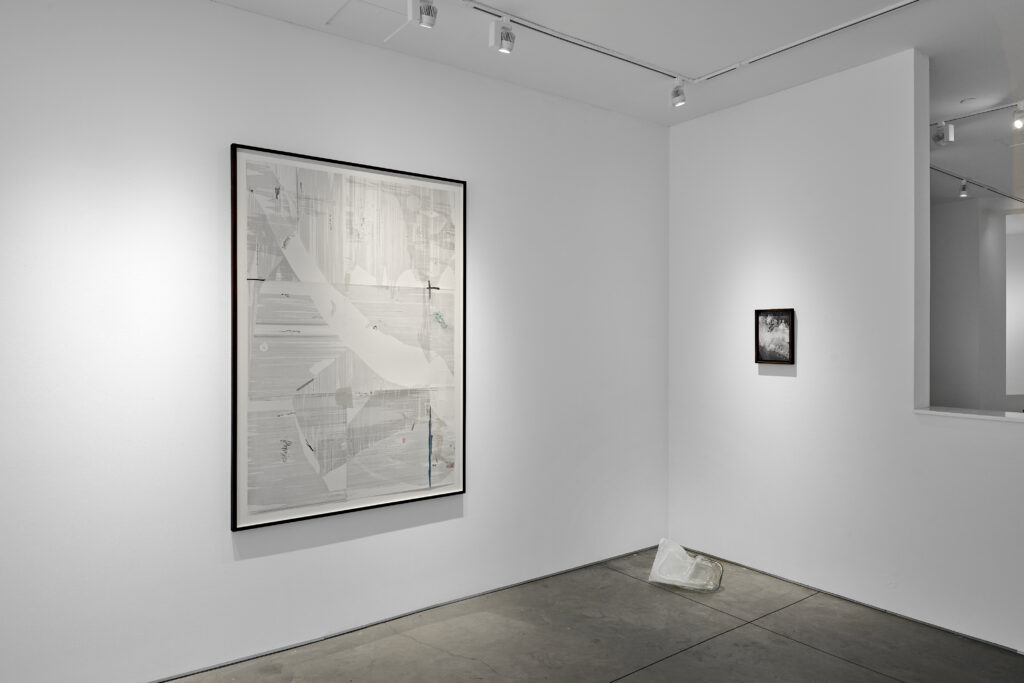
Lines and logic jolted by movement and actuality; soft forms clouded by their composites; words and wits, a visual play choreographed by the gestural motions of wading and cascading. ‘In the Whitewater’ by Macarena Rojas Osterling marks the Peruvian artist’s first solo exhibition in New York at Praxis Gallery. Through drawings, paintings and sculptures, the major show unpacks that instant, moment and feeling, of being in the break of a wave, or indeed – whitewater. A metaphor for life’s tumultuous, shattering yet exhilarating moments, it also speaks to Osterling’s background: growing up by the Peruvian coast in Lima, taking to the Pacific Ocean as a surfer for respite and reset. Engrained in Osterling’s pieces is this tension, between her training as an architect, which implicated a rigour and non-expressive precision, and her daily reality as a mother of two, with all of its unexpected beauty, mess and sparks of play. To encounter Osterling’s works is to enter a world of composites, different realities, amas-sed and overlaid openly into one. She is a master draughtswoman but equally a sculptor, an observer of the quotidian but crucially an expressor of sentiment. Raw and poignant, yet delicate and rough, ‘In the Whitewater’ swells and tumults, propelling us into a world of articulated complexity.
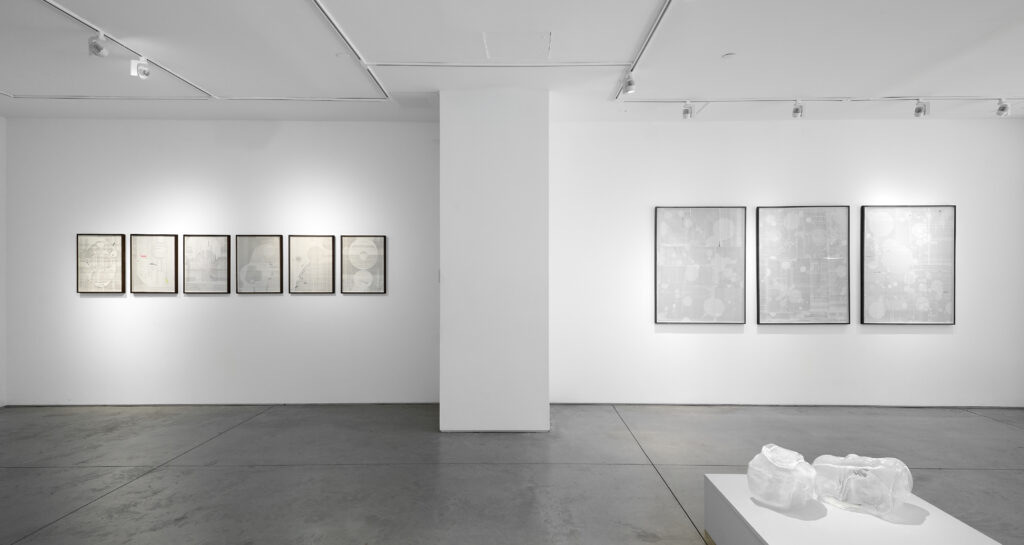
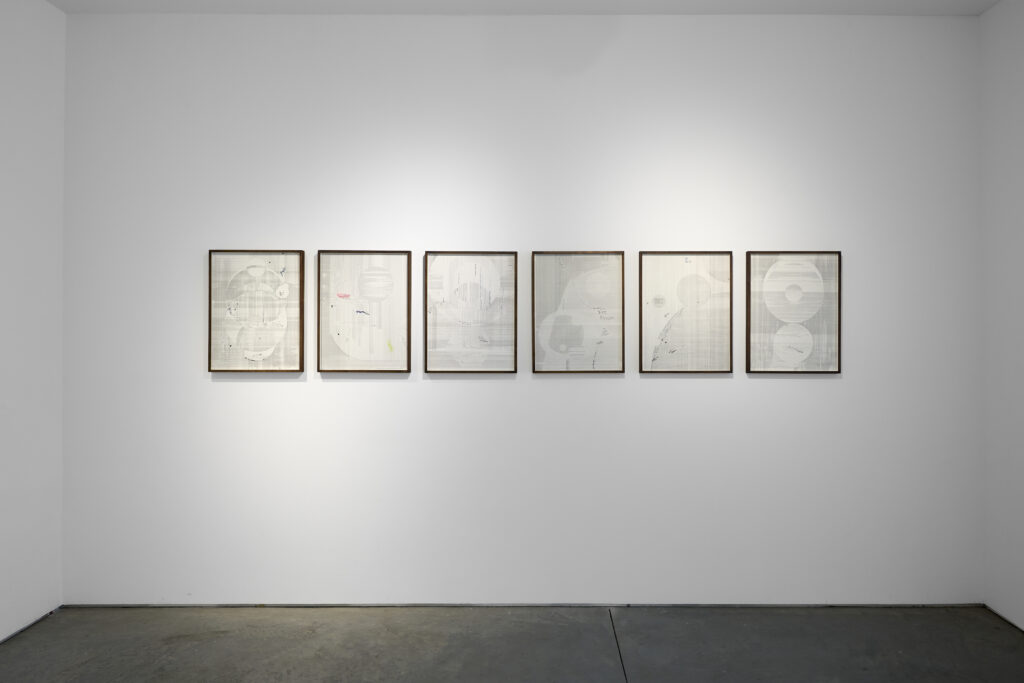
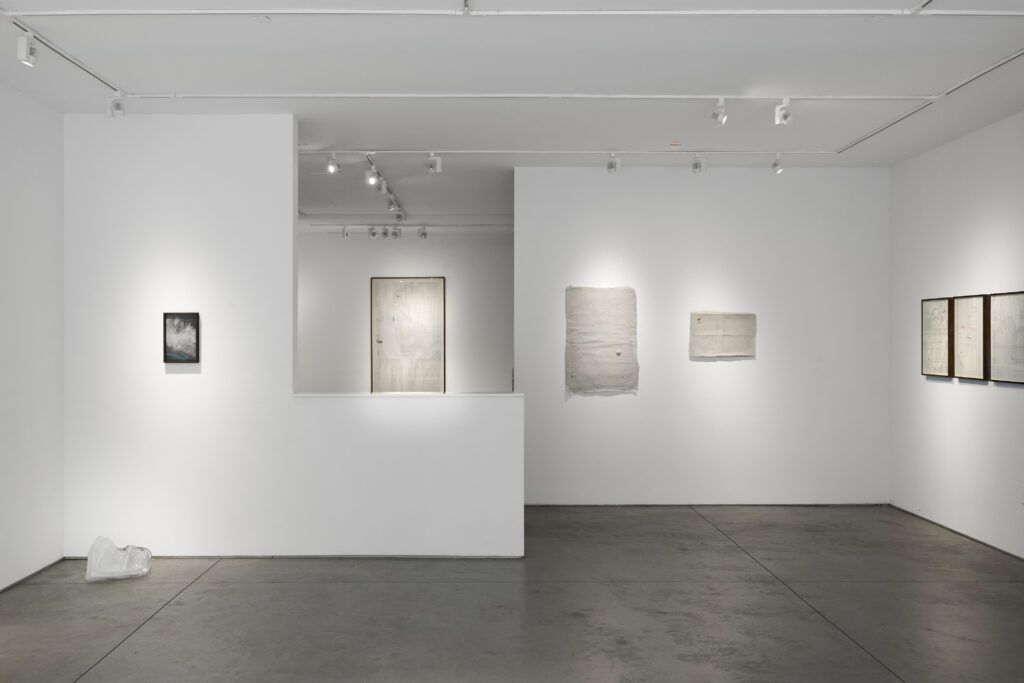
At the core of Osterling’s practice are her drawings. Line by line, she reveals these cosmic orbs that verge on the edge of musical annotation. At moments, the lines break. They shift. Divert. At times ‘just because’, on other occasions because a word comes in. Sometimes these are by her hand – other times one of her son’s. The organic methodology of these works dates back to Osterling’s masters at the Royal College of Art in London. A mother to a one year old at the time, she worked, for practical reasons, on smaller pieces of paper, bringing them to university and then back home, working on them on the kitchen coun-ter while tending to her infant. The pauses, the breaks – the permittance and necessity to take these – to respond to life’s realities, are evidenced across the paper. The page – and pages – grew with her and her children. As they got older they all contributed, mother and children; a line here, a word there, spontaneously. English and Spanish slipping through, lyrics from favourite reggaeton songs – reminders of another life. Reading like mnemonic maps, these works are charged with memories of where they were made, the time it took to make them, a frenetic zeal and emotive tenderness; an incredibly generous exchange between Osterling’s universe and our wider world. The drawings also read like the delineations of breaking water; how it rushes up onto the shore, suspending then fractured, unbounded by control, only to then retreat.
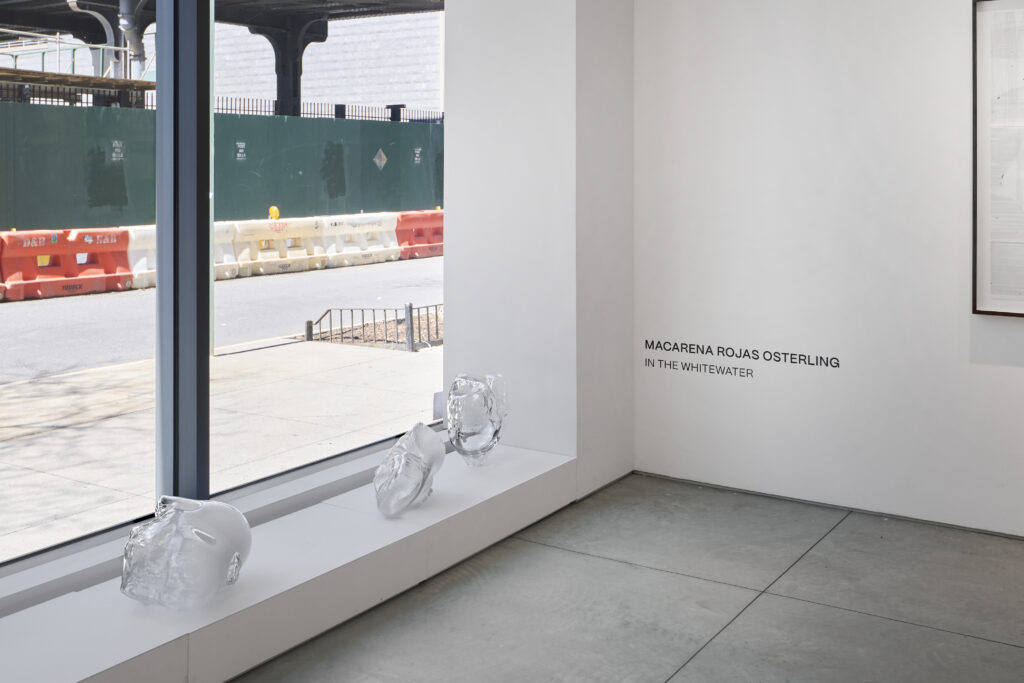
From this register of impossible obedience, a parallel and opposite existence emerges through Osterling’s sculpture. Made of glass, these moulded and blown sinuous blocks belong to the realm of cloudy asteroids or unearthed geological formations – mementos of deep time. Viewed alongside the drawings, they seem to be physical evocations of the celestial forms that appear on the paper, or that experiential instant of breaking water coming to a standstill: the molecular froth, curdling on the shore, propagated by the intensity of a crashing wave. Indeed, the sculptures appear to freeze the ‘in between’; an instant that hovers between liquidity and solidity, control and release, holding and abandoning. Their physical delicacy and precarity expresses Osterling’s bodily encounter when out in the ocean; as described by Osterling, “they echo the sensation of being wrapped, pulled, and held within a dense, unstable medium”. Despite them being fixed forms, the way they capture the light and let it settle yet divert, brings to them an innate movement, one that is subtle, like a fading memory. In their disposition, their volumes and presence, these sculptures express the concept that even when we try to stand still, hard as we might, there is still pulsing, breathing, beating – or indeed, living.
This sense of the bodily is further emphasised by Osterling’s paintings. Composed of canvas, drawings, paint and emulsion, they resemble shards or a skin that once held the sculptural work and/or that the drawings evolved into. Delicate yet rough, their texture speaks to the wet sand once a wave has passed, or the granules that caress and crease one’s bare body. Their scale is important: similar to the drawings, there is a sense of their practical transportability, their making being one of intermittence and layering, letting one part build, settle, only to rebuild. In a sense, it counteracts the feeling of being in the whitewater where crucially one does not have time to gather; it all happens at once, an unplanned cascade and tirade of nature, propelling us at its whim. In her wider body of work, thus, Osterling’s paintings stand as a counter-narrative, the seemingly unachievable stillness between her drawings and sculptures that each reflect various spectrums of a constantly moving reality.
When looking back and ‘in’ at Osterling’s practice and contextualising it we quickly realise that it doesn’t belong to one art historical world. The drawings don’t strictly exist in the world of draughtsmanship. In their patterning and trace-like precision they feel more akin to the Concrete movement, with artists such as Lygia Pape, or that of conceptual art and minimalism, with the likes of Sol Le Witt. The sculptures in their morphed cuboidism and clean lines hark to the likes of an organic Donald Judd or in their play with light Olafur Eliasson. They even seem to belong to the universe of weaving, looking to artists such as Anni Albers, or that of humour and dance with Miró and Kandinsky. While the paintings, in their rigid fluidity and layering, exist in the world of artists interested in architecture and the body such as Heidi Bucher. In this sense, Osterling is creating her own language, her own breaking of bounds: a multi-hyphenate practice that exists in the world of bodily and emotive expression, procedural precision, and the conceptual articulation and stripping back of noise to reveal a core.
Ultimately, ‘In the Whitewater’ is an exhibition around acknowledgment, actuality and process. Intense and real, it lures you in with its visual delicacy and appearing softness only to reveal a beautifully, joyfully and at times painfully raw entanglement. Much like the ocean, the exhibition and Osterling’s practice isn’t shy or apologetic, polite or subdued; it pulls the tension strings between calm and abounding, and, like a wave, wraps us in its evocative roar.