Praxis is pleased to present Time, Space and Change: Taking Sanctuary in Nature, a solo exhibition by Brenda Perry-Herrera (b. Juarez, Mexico, 1978). The exhibition will be open from November 18th until January 15th 2022.
This exhibition includes Brenda Perry-Herrera’s latest body of work, created during a time of isolation as a result of both the quarantine and the birth of her child. Perry-Herrera continued with her featured experimentation of traditional photography techniques, like mixed media cyanotypes on paper and peep boxes with pinhole camera images.
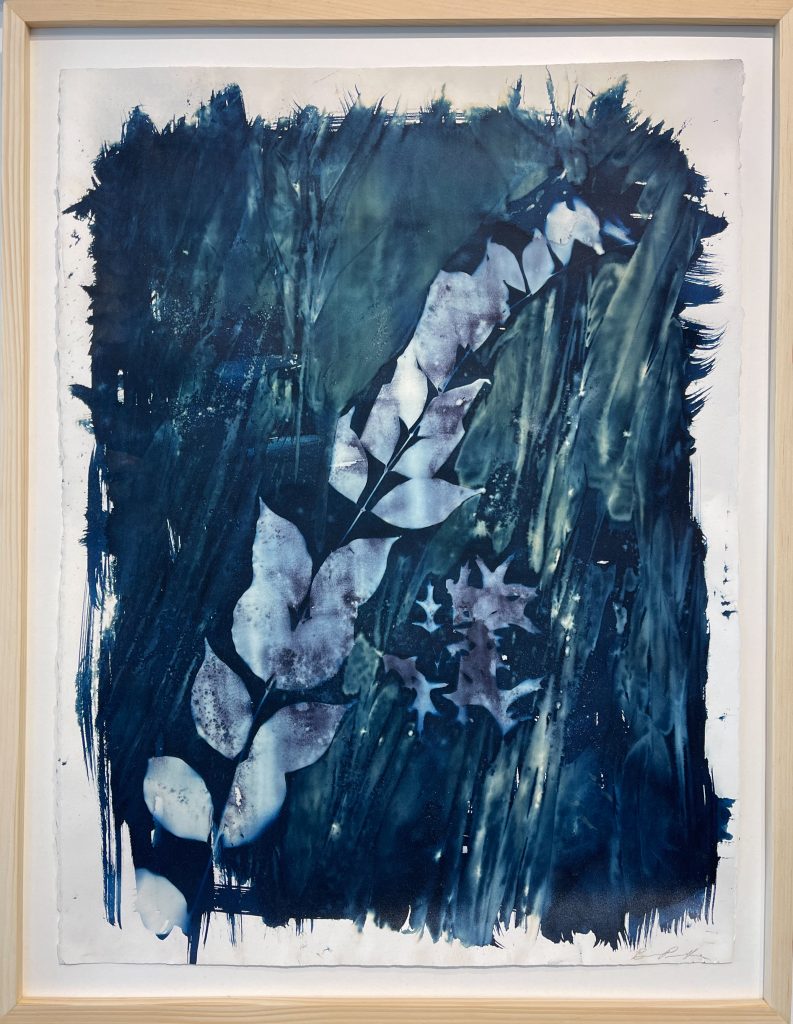
A true advocate of environmental issues, her new pieces reflect on the uncertainty of climate change and the biological changes that it conveys in humanity and the world, as we have forgotten and neglected the nourishment that nature provides. The textures and tones on her cyanotypes on paper resemble that of molecular photography, and the choice of beeswax acts as a “preserving agent” to the unpredictable unraveling of the world around us. Her notorious brush strokes reveal the human element in an otherwise “mechanical” technique -as photography was traditionally regarded in it’s origins-. This conjunction between the artist’s hand and the photographic medium suggests a twofold gesture in which both machinery and nature intervene. This artisanal component of Perry-Herrera’s work is simultaneously intertwined with a chemical process over which the artist has partial control. Chance is thus introduced as an active factor of this body of work, intrinsic to the artist’s technique. On a metaphorical level, Perry-Herrera’s cyanotypes speak about the overwhelming presence of man in the environment in present times. In a nostalgic manner, however, they also introduce the viewer to methods traditionally used in the Nineteenth Century, that require a slower pace and the sun’s intervention for its production.
In her mixed media pieces, Perry-Herrera converges her interior and exterior worlds as her private home and public life merged into a confusing one. With a melancholic tone and by hiding clean edges, she reflects on life and decay during a time where she found sanctuary in clustering nature with her home. Indeed, for these works she was inspired by what surrounded her. The garden, foliage, and flowers from her home, and the spices from her kitchen, they all serve as inspiration for a work where nature and home become one. These works transmit the intrinsic calm of a sanctuary, replicated in the cyanotype process itself, in which a photographic print is obtained by meticulously coating paper with light-sensitive chemicals and exposing it to the sun. The paper is finally developed, washing away the water soluble chemicals in the print. This produces a Prussian blue image -thus the name “cyanotype”- of different intensities which vary according to the length of the exposure or the environmental factors such as the amount of daylight on a given day. This addition of careful steps, which demands the printmaker’s fully devoted attention, along with the resulting monochrome blue images, talk about Perry-Herrera’s practice as a meditative process. Culturally and historically, the color blue has always been associated with the calming nature of oceans, the melancholic atmosphere in blues music and the hypnotic infinity of the skies.
While the thread in the pieces refers to the collective anxiety we experienced during lockdown, the stitching gives a glimpse of the manual gesture. The sewing links the pieces to the maternal lineage of skilled seamstresses and brings to the forefront the industry-craftsmanship binomial. The shadow cyanotypes are an account of time and space during quarantine, a time for Perry-Herrera which also coincided with the birth of her second child. The blurry out of focus aspect denotes her introspective look into motherhood and ties her work to predecessor Anna Atkins, considered one of the first female photographers who also happened to be a botanist. Even further back, Perry-Herrera evokes a long tradition of women artists who worked with the still life genre and painted nature, more specifically flora, throughout Art History. However, it would be naïve to regard her pieces as the revival of a vintage technique, when in reality, Perry-Herrera subjects are tainted by both the urgency of climate change and our corresponding responsibility to revert it. Her peep boxes with pinhole camera images inside invite us to imagine a different, more intimate relationship with nature, in which much of human activity has ceased and the wildlife is allowed to thrive again.