Macarena Rojas was born in 1985 in Lima, Peru. She studied Architecture at the Universidad Peruana de Ciencias Aplicadas and subsequently transferred to the Communications Department, where she graduated in 2009. In 2012 she did the General Studies in Photography Program at the International Center of Photography in New York and in 2017 she received her Masters in Fine Arts at The Royal College of Art in London. Her work has been exhibited in Black Box Projects Cromwell Place London (2022), Crisis Galería Lima (2019), Art Lima (2018), Museo AMANO Lima (2018), Camden Arts Center London (2017), Edinburgh College of Art (2016), Museo de Arte Contemporáneo Lima (2016), ArtBo Bogotá (2016), Museo Nacional de Bellas Artes, Santiago de Chile (2014), Wu Galería (2014-2015), International Center of Photography New York (2012), Triskelion Arts New York (2013), amongst other public and privately held exhibitions.
She lives and works in Lima.
Rojas Osterling’s work can currently be viewed in Look How Brightly, a group exhibition at London’s Britannia Row curated by Jenn Ellis and Alex Mills, which brings together artists whose practices interrogate questions of identity, absence and presence, fragmentation, and transcendence. Osterling’s solo exhibition In The Whitewater is currently on view at Praxis in New York through July 10, unfolding a body of work that moves between pressure and release, where forms seem to dissolve and re-emerge in shifting states.
You were based in the UK for many years before returning to Peru. How has being in your home country affected your artistic practice?
I was based in the UK for many years — I did my master’s at the RCA — and honestly I still feel like I’ve only just returned home. I think the thing I’ve valued most about being back in Lima is having the Pacific Ocean five minutes away from me. In many ways, I think the ocean completely infiltrated the newer works.
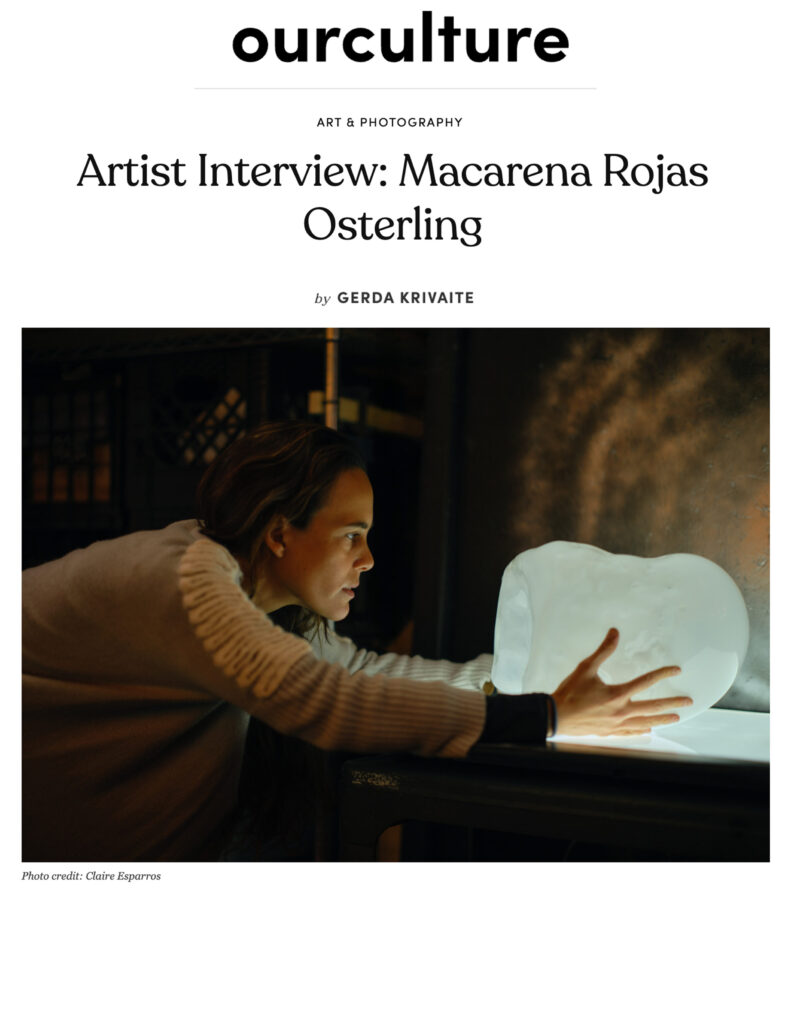
It probably drew me toward the glass sculptures first. They appear very different from the drawings because they’re pristine, almost clinically clean — no scratches, no visible chaos — but the process itself is actually incredibly intuitive and messy. Even when I’m trying to extract or hold a very specific gesture of water, the making process involves surrender and unpredictability.
The same happens in the collage paintings. They carry traces of sand, salt, erosion, water damage… The papers almost feel as if they’ve been submerged in the ocean for years. There’s a fragility to them that interests me a lot.
I think returning to Peru affected the newer works more directly. The drawings are different because drawing is something I’ve done my entire life. They almost transcend geography for me. They mutate in language, density or form, but the impulse behind them remains very constant wherever I am.